Contrary to the narrative that machines are coming for our jobs, the rise of Artificial Intelligence paints a more intricate picture on the canvas of employment. Sure, routine and repetitious tasks stand in the line of fire, but what emerges from the smoke is not unemployment, but transformation. It’s crucial to understand that a larger, more significant shift is unfolding – the birth of the ‘Augmented Human’.
This concept symbolizes a new breed of workers, enhanced and elevated by AI rather than replaced. This evolution in the job market is our central theme, underscoring an imperative to adapt and strengthen our place in the age of AI.
Demystifying AI: Not Job Stealers, but Task Transformers
Does it feel like a robot invasion is imminent, threatening to snatch jobs right from under our noses? This fear isn’t entirely unfounded, but it isn’t accurate either. Reality stands in stark contrast to this dystopian tale, with AI serving as a labor-saving, task-automating device rather than a job-erasing monster. The essence lies in comprehending the critical difference between task automation and job extermination.
Consider that AI thrives in environments fueled by predictability and optimization. Still, it falls short when creativity, critical thinking, and emotional intelligence are called for – the hallmarks of human intelligence. Instead of replacing human jobs, AI is carving out new roles and reshaping the traditional ones, contributing to widespread task-level automation. This change gives birth to what we call the ‘AI-Augmented Workforce’; an evolution less about competition and more about collaboration between humans and AI.
So, it’s not a case of robots stealing all our jobs. Instead, AI is altering the nature of many jobs, fostering a new ecosystem where our roles change, become more complex, but ultimately, remain inherently human. Such a transformation of the job market is beyond mere automation and calls for the rise of the ‘Augmented Human’ wielding the power of both AI and human adaptability.
Decoding the ‘Augmented Human’: An Evolution in Productivity
Bridge the gap between the worker and the work. Imagine being a pilot to the powerful co-driver that is AI in your professional journey. Let’s take a glance at data analysis. Instead of trudging through numbers manually, imagine an AI tool supplying you with precise predictions and patterns instantly.
The same tool would free a marketer from crunching consumer behaviour data, offering clear-cut demographic insights and trend forecasts instead. In content generation, AI could suggest writing improvements, sparing authors the brunt of syntax and grammar check.
It’s no different for designers and developers; an AI assistant could rapidly generate wireframes or troubleshoot code when they hit a wall. Customer service has seen sweeping changes as well, with AI chatbots handling routine queries while the human agent tackles complex problems. This is the core definition of an ‘Augmented Human’, acting as an orchestra conductor in the symphony of AI and human intelligence.
Your role isn’t simply about executing tasks anymore. Essentially, it’s about interpreting and orchestrating AI’s capabilities to better serve your professional goals. So, as you find yourself in this evolving world of AI-enhanced job roles, remember that it’s not about doing all the work – it’s about utilizing AI to work smarter, faster, and more efficiently.
Skillset Essentials for Navigating an AI-Driven Job Market
In this AI-centered career landscape, your traditional skills might need some new co-stars.
So, let’s explore the key abilities that will rise in demand as AI continues to shape the job market:
- Prompt Engineering: Sounds fancy, right? But it simply means mastering the art of clear, precise communication with AI. Here’s the clincher – a misunderstood instruction, a misinterpreted command, and the output swings way off track. Your goal? Minimize ambiguities and command AI with confidence.
- Critical Thinking: Evaluating AI outputs isn’t about accepting or rejecting what the AI churns out. It’s about turning a detective’s gaze on these results, assessing their validity and relevance to the task at hand. AI may fall short here, but your seasoned critical thinking skills won’t.
- Creativity: It’s now your front seat in the career rollercoaster of an AI-driven job market. AI might replicate a famous painting or compose a catchy melody, but human creativity will always outpace it. Your ability to generate unique, novel ideas becomes vital amidst repetitive AI patterns.
- Emotion Intelligence: A trait inherently yours, something that AI is still learning. Navigating a matrix of human emotions, empathy, understanding – these are gold in fields where humane interaction remains at the core. AI will lag, and your emotional intelligence will lead.
- Adaptability: This trait isn’t about surviving; it’s about thriving. In a landscape punctuated by constant change, adaptability becomes your passport to success. Continuous learning, evolving in the face of challenges – these will guide you in the progressive dance with AI.
Remember, the AI job terrain will have its upheavals, but arming yourself with these skills can provide a strong foothold. It’s about empowering you to not only withstand the AI revolution but contribute to its evolution as well.
Empower Yourself with AI: A Roadmap
Upskilling or reskilling in an ever-changing AI landscape might sound daunting at first. Let’s pull back the curtain on that fear. A ceaseless appetite for learning and experimentation in AI tools is your ally here.
Dabble with a diversity of resources from online courses and AI communities to hands-on projects. Pull these strings together, and you’re well on your way to advance in this evolving job market.
Don’t rest on these laurels though. Understanding how AI is affecting the job market is almost a rite of passage. Wrapping your head around this could be a steep climb. Time to turn the spotlight on an AI homework helper. It crushes complex reports and academic papers to simpler, digestible pieces. A tried-and-true way for students and professionals alike to promptly understand new concepts and embed them into their skills framework.
This plunge into AI is not a swan dive into the unknown. It’s the beginning of your journey as an ‘Augmented Human’. Learning and adapting are your true north in this exploration. Brace yourself for the thrill of discovering uncharted territories in the vast realm of AI.
Job Landscape Transformed by AI: A Closer Look
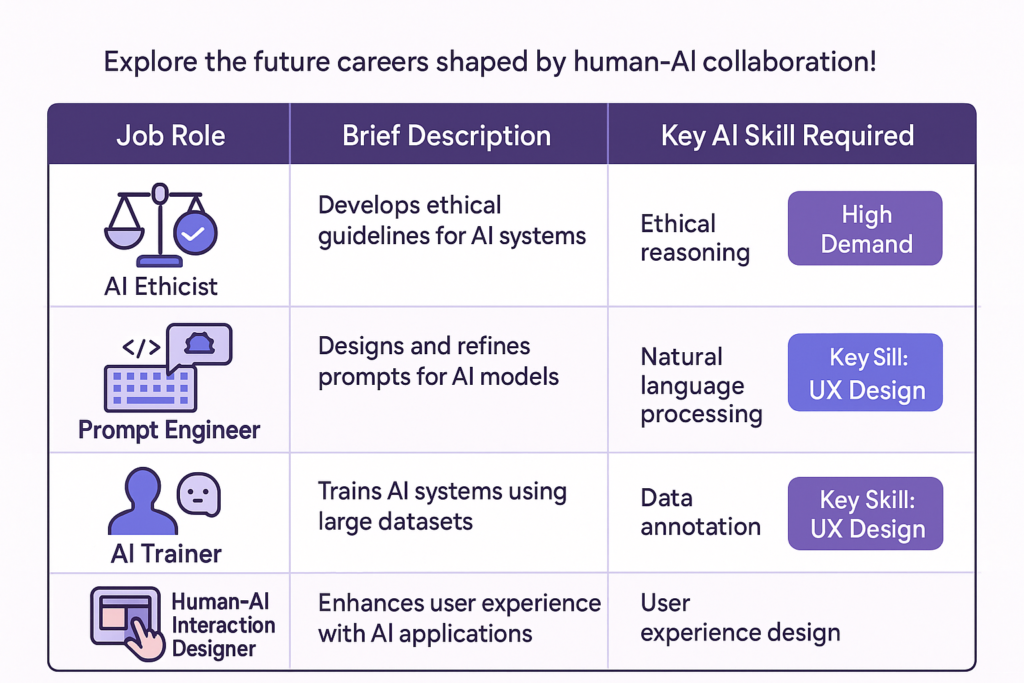
This burgeoning AI era ushers in an array of unique job roles that marry original human capabilities with AI’s processing power. Let’s delve into the exciting fusion these roles represent, focusing on tasks that need insightful human oversight and inventive creativity to function seamlessly alongside AI.
| Job Role | Brief Description | Key AI Skill Required |
| AI Ethicist | Creating guidelines for ethical AI usage, assessing the impact of AI applications on society | Understanding of AI’s societal impact |
| Prompt Engineer | Crafting precise, unambiguous prompts that drive AI operations, reducing the risk of misinterpretation | Proficient in prompt engineering |
| AI Trainer | Training AI models, refining their learning through iterative feedback loops, ensuring AI behavior aligns with intended outputs | Skilled in machine learning workflows |
| Data Ethicist | Ensuring ethical use of data, conducting audits for algorithmic fairness, and privacy | Grasp of data and privacy laws |
| AI Solutions Architect | Designing comprehensive AI solutions, aligning AI capabilities with business or operational goals | Versatile in AI system design |
| Human-AI Interaction Designer | Constructing immersive user interfaces for human-AI interaction, optimizing user experience | Fluent in User Experience Design |
Transitioning into these dynamic roles could be a fulfilling leap, harnessing unique human skills in synergy with AI’s immense capabilities. Equipping yourself with the mentioned key AI skills could steer you towards a promising career trajectory, painting you as an ‘Augmented Human’.
AI-Ready Workforce: A Checklist
As businesses start to navigate the AI revolution, their focus should shift towards cultivating AI proficiency among their employees. This upskilling is not merely about coding and AI mechanics but about fostering an AI-centric mindset.
Here is a checklist to guide organizations in preparing their workforce for the AI era:
- Introduce AI literacy programs: Nurturing AI competence across all levels of the organization is vital.
- Foster a culture of experimentation: Encourage employees to dabble in various AI tools and frameworks.
- Reshape job roles to accommodate AI: Design roles to leverage AI and human skills symbiotically.
- Emphasize on human-AI collaboration: Knowledge workers could be productive allies to AI, rather than competition.
- Lay down ethical AI guidelines: Promote responsible AI use, guarding against misuse or unintended biases.
- Boost continuous learning initiatives: Support continuous learning and keep the workforce agile amidst ever-evolving AI breakthroughs.
Implementing these steps will help companies leverage AI’s potential while steering the workforce towards an era of ‘Augmented Humans’.
AI and the Job Market: Debating the Pros and Cons
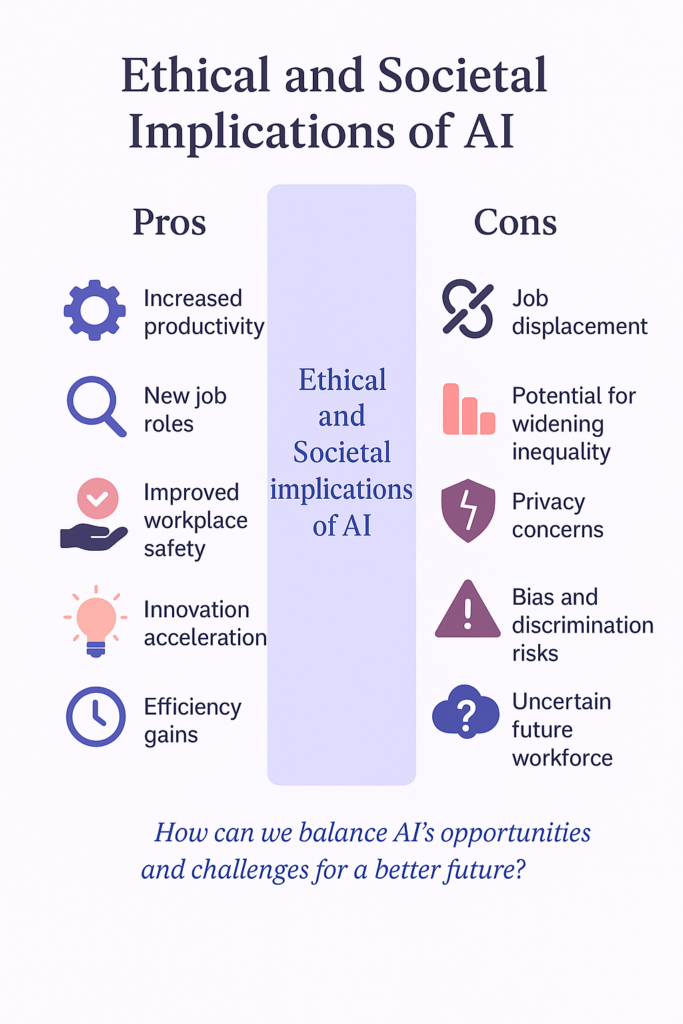
The promise of AI in reshaping the future of work paints a compelling picture, but it’s not without its challenges.
Let’s explore both sides:
Pros:
- Productivity surges as repetitive and mundane tasks find their match in AI’s efficiency.
- Entirely new industries emerge, promising fresh job opportunities and exciting career paths.
- Work becomes more meaningful as AI takes on manual tasks, freeing humans for higher-value roles.
- BSiness decisions benefit from data-rich insights that AI can deliver, improving operations.
Cons:
- There’s a fear of increasing inequality, especially if AI skills remain concentrated in the hands of a few.
- To mitigate job loss due to AI, stronger social safety nets will become indispensable.
- Ethical dilemmas will arise from deploying AI, demanding guidelines for use and accountability.
- Algorithmic bias in AI hiring tools may unintentionally promote discrimination, warranting ongoing scrutiny.
The interplay of AI within our job market is a complex tale. It reminds us that every technological leap demands thoughtfulness, not just in harnessing its benefits but also in managing its risks and implications.
AI as an Ally: The Rising Synergy
AI doesn’t have to be seen as an opponent stealing jobs, but rather, as an advantageous ally that can boost our productivity and creativity. The future might seem uncertain, but those who understand the importance of adapting and learning alongside AI will emerge as leaders in the new era.
The key takeaways here are thus:
- View AI as a collaborator, not a competitor.
- Adaptability and continuous learning are non-negotiable as we move deeper into the AI era.
- To work with AI is to work towards the future of employment.
Embrace AI, Empower Yourself
Many approach AI with understandable concern. Although its impact on job markets can feel threatening, we must remember that every disruptive technology brings similar apprehension.
Rather than being daunted by inevitable automation, why not seize the chance to transform ourselves into augmented humans? Equip yourselves with AI literacy, harness it for creativity, productivity, and, most importantly, become an active agent in shaping your own future. In this time of revolution, the ability to adapt and learn is paramount.
Don’t wait for the future – start developing your AI-enhanced skills, and join in crafting a shared, inclusive future of work today.